AI-200 Study Guide: Azure AI Cloud Developer Associate (AZ-204 Replacement)
AZ-204 is gone. Microsoft retired the Azure Developer Associate exam on July 31, 2026, and replaced it with AI-200: Developing AI Cloud Solutions on Azure, which earns the Microsoft Certified: Azure AI Cloud Developer Associate certification.
This isn't AZ-204 with a new number. About half of the outline is new: vector search in Cosmos DB, pgvector in PostgreSQL, Azure Managed Redis, KEDA, AKS and OpenTelemetry. Blob Storage, API Management and Microsoft Entra sign-in are gone.
This guide covers who the exam is for, what to expect on the day, and where to focus. It finishes with the full exam outline, item by item, each linked to the Microsoft Learn documentation for that skill and, where one exists, a hands-on CloudLearn lab. The post is long, so use the table of contents and bookmark it.
Study guides for other exams:
- Azure DevOps Exam Guide (AZ-400)
- Azure Network Engineer Exam Guide (AZ-700)
- Azure Developer Exam Guide (AZ-204, retired)
Certification Overview
AI-200 is an associate-level exam for developers who build the back end of AI applications on Azure. It isn't a data science or model-training exam. You won't train a model. You'll build the services around one: the containers that host it, the databases that store embeddings, the queues that feed it work, and the monitoring that tells you when it breaks.
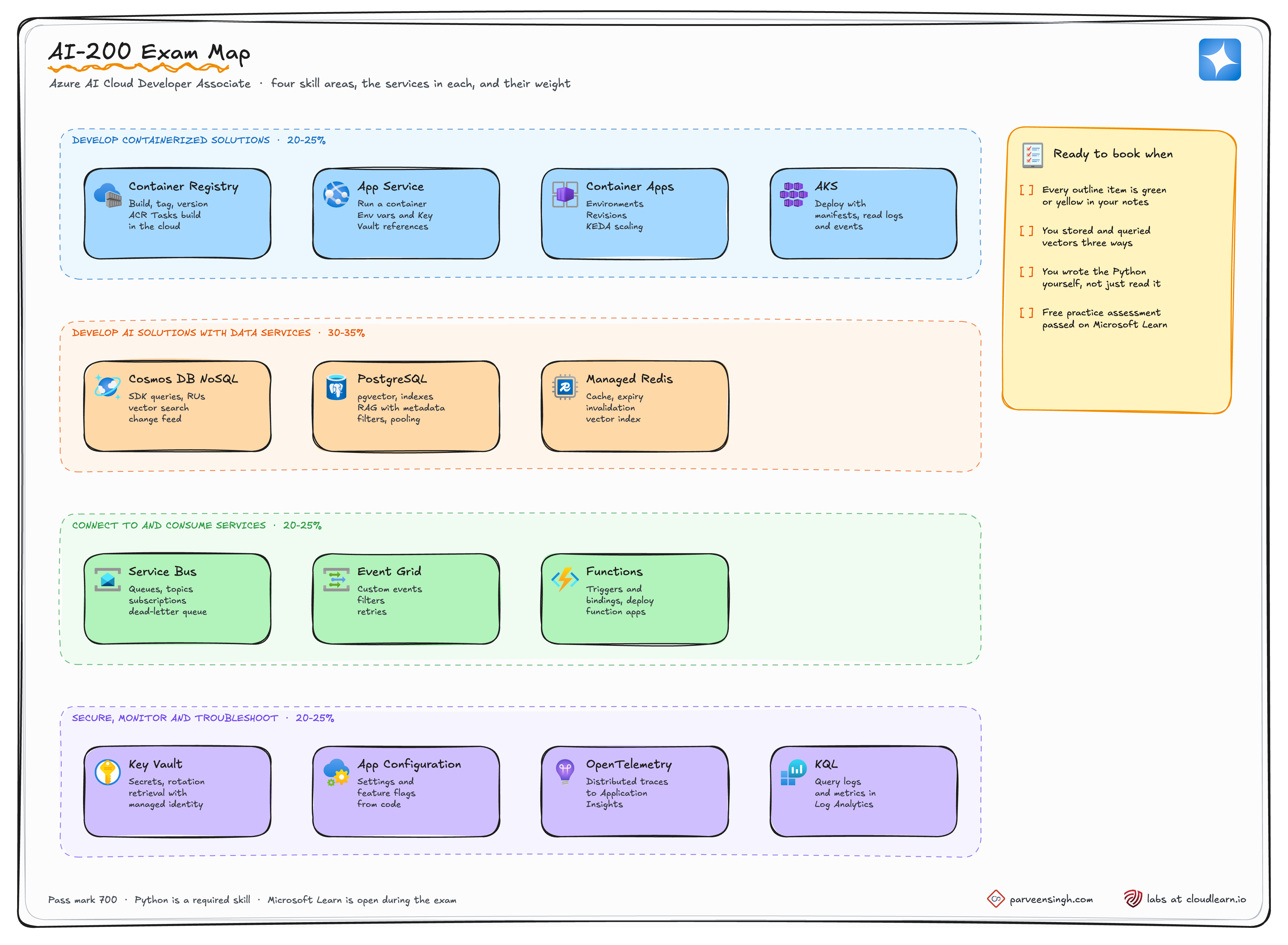
Click any diagram to zoom in.
Microsoft groups the exam into four skill areas:
| Skill area | Weight |
|---|---|
| Develop containerized solutions on Azure | 20–25% |
| Develop AI solutions by using Azure data management services | 30–35% |
| Connect to and consume Azure services | 20–25% |
| Secure, monitor, and troubleshoot Azure solutions | 20–25% |
The data management area is the heaviest, and Microsoft raised its share from 25–30% to 30–35% on October 7, 2026. It's also the newest material. That's where most people coming from AZ-204 will need the most time.
What Changed From AZ-204
If you studied for AZ-204, part of this outline will look familiar. Here's what moved:
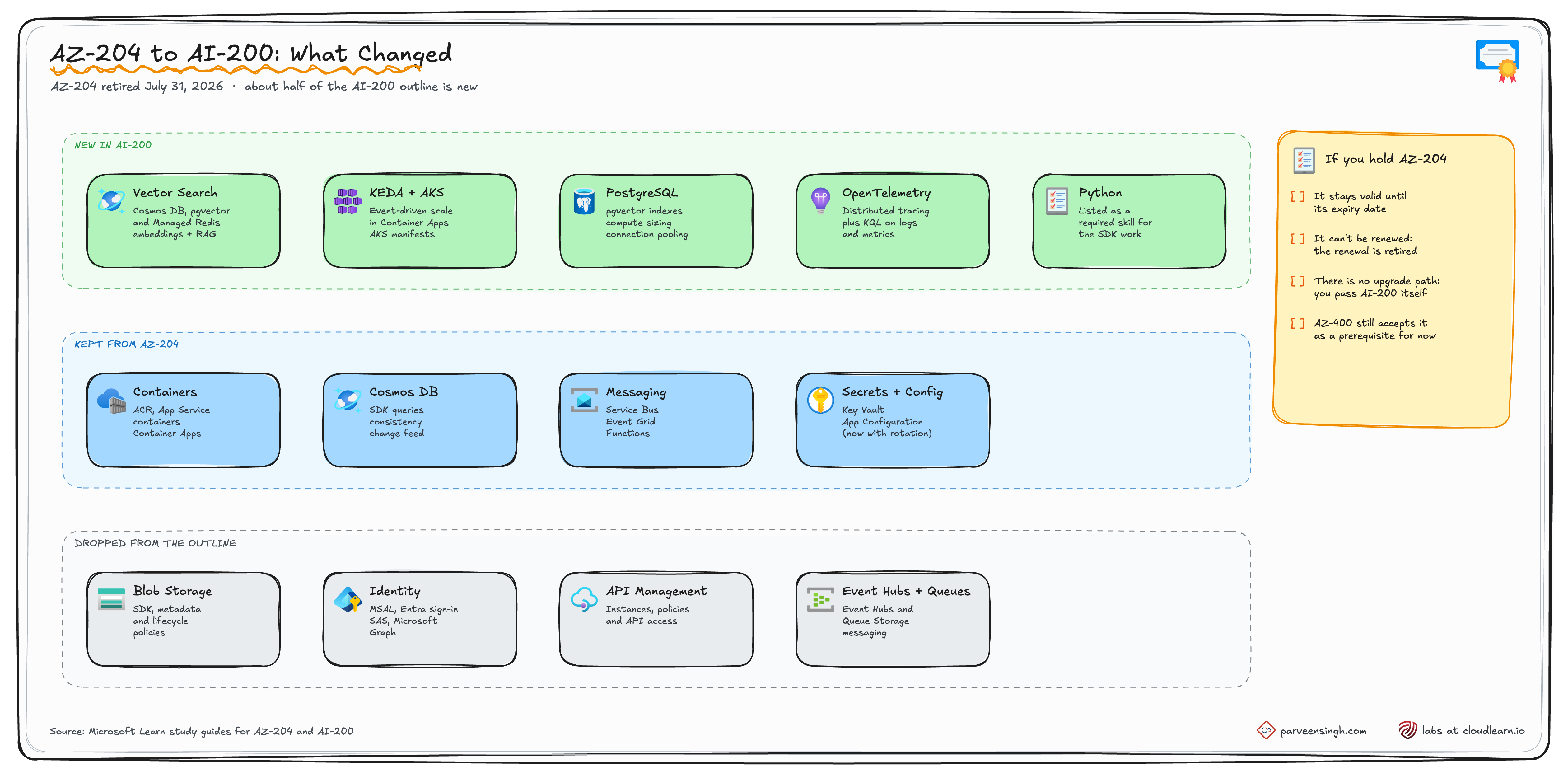
| AZ-204 (retired) | AI-200 | |
|---|---|---|
| Containers | ACR, Container Instances, Container Apps | ACR and ACR Tasks, App Service containers, Container Apps revisions, KEDA, AKS |
| Web apps | App Service: slots, autoscale, TLS, diagnostics | App Service only as a container host |
| Data | Cosmos DB, Blob Storage | Cosmos DB with vector search and change feed, PostgreSQL with pgvector, Azure Managed Redis |
| Identity | Microsoft identity platform, Entra ID, SAS, Microsoft Graph | Not in the outline |
| Secrets and config | Key Vault, App Configuration, managed identities | Key Vault with rotation, App Configuration |
| Messaging | Event Grid, Event Hubs, Service Bus, Queue Storage | Service Bus (including dead-letter queues), Event Grid |
| APIs | API Management | Not in the outline |
| Monitoring | Application Insights, availability tests | OpenTelemetry tracing, KQL |
| Language | Any supported language, mostly C# in practice | Python listed as a required skill |
If you already hold AZ-204
- Your certification stays valid until its current expiry date.
- It can't be renewed. The renewal assessment was retired along with the exam.
- When it expires, it stays on your Microsoft Learn transcript as expired.
- There's no upgrade path. To hold the new certification, you pass AI-200.
Note: AZ-204 was one of the two prerequisites for the DevOps Engineer Expert (AZ-400) certification. Answers on Microsoft Q&A say AI-200 will be added as a prerequisite, but at the time of writing the certification page doesn't confirm it. If AZ-400 is your goal, check the DevOps Engineer Expert page before you pick a path. AZ-104 is still an accepted prerequisite.
Exam Prerequisites
There are no formal prerequisites. You can book AI-200 without holding another certification. In practice, you'll struggle without these:
- Python. Microsoft lists it as a required skill, and the SDK questions are written with it in mind. You should be comfortable reading and writing Python that uses the Azure SDKs. If you're new to it, start with Microsoft's Take your first steps with Python.
- Azure basics at AZ-104 level. Resource groups, RBAC, managed identities, networking basics and the Azure CLI. You don't need the certification, but you need the knowledge.
- Docker. Building an image, tagging it, and running a container locally. Most of the first skill area assumes this.
- Embeddings and RAG concepts. What an embedding is, what a vector similarity search returns, and what retrieval-augmented generation does with the result. You won't build a model, but you'll store and query its output.
- Git and a command line. If either is new, Git vs GitHub vs GitHub Actions and Bash Scripting for Beginners cover what you need.
Who Is This AI-200 Exam For?
Take the exam if:
- You're a back-end developer building or maintaining applications on Azure.
- You were planning AZ-204. This is now the developer associate exam.
- You're a developer moving into AI applications and want to prove you can build the infrastructure around a model, not only call an API.
- You're a DevOps or platform engineer who deploys containerized apps and wants a developer-track certification.
It's probably not the right first exam if:
- You've never written code. Start with Python and the Azure fundamentals first.
- You want to train, tune or evaluate models. That's the AI engineer and data scientist tracks.
- You're an administrator with no development work. AZ-104 is a better fit.
What to Expect in the Exam
- Passing score: 700 out of 1,000.
- Length: Microsoft lists role-based associate exams at 100 minutes, or 120 minutes if the exam includes labs. Allow extra seat time for the instructions and the candidate agreement. See Microsoft's exam duration and experience page for the current numbers.
- Questions: most Microsoft exams have 40–60 questions. Expect a mix of single-choice, multiple-choice, drag-and-drop, case studies, and yes/no problem-solution sets that you can't go back to.
- Microsoft Learn is available during the exam. Associate exams let you open learn.microsoft.com from inside the exam. The clock keeps running while you browse, and you won't have time to look up every question. Use it for the one or two details you can't remember, such as a CLI flag.
- Breaks: 5 minutes are built in. Once you start a break, you can't go back to questions you've already seen.
- Preview features: most questions cover generally available features, but Microsoft says commonly used preview features can appear.
- Practice assessment: Microsoft now has a free AI-200 practice assessment. Take it once early to find your gaps and again in the last week.
- Exam sandbox: try the exam sandbox once before your exam so the interface isn't new on the day.
Exam Preparation Recommendations
The exam covers a lot, so put your time where the weight is:
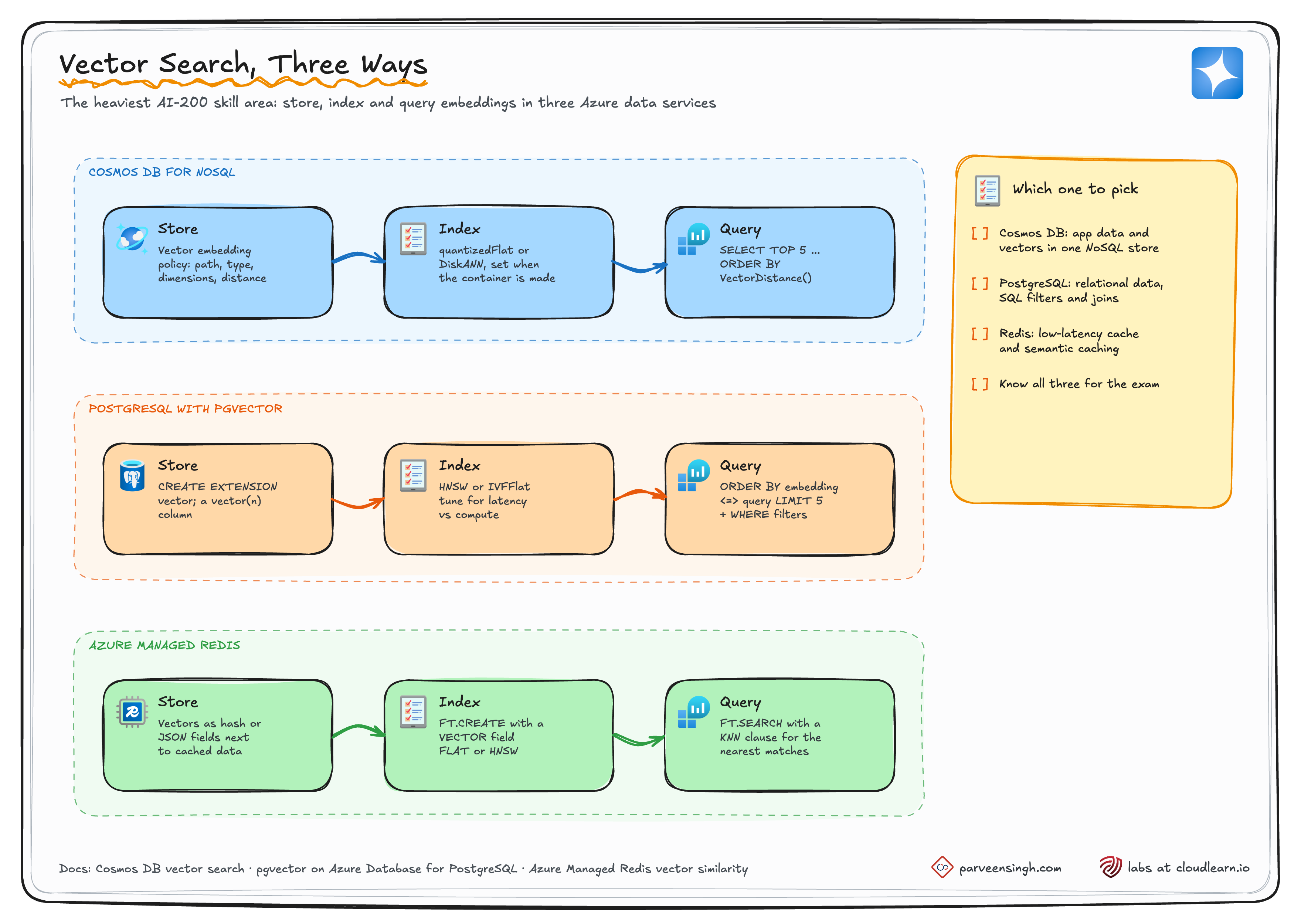
- Vector search, three ways. Know how vectors are stored, indexed and queried in Cosmos DB for NoSQL, PostgreSQL with pgvector, and Azure Managed Redis, and when you'd pick each one. This is new material for most people and the heaviest area.
- Cosmos DB costs. How indexing policies and consistency levels change the Request Unit (RU) charge of a query. In Cosmos DB, you can add or remove vector paths on a container later, but you can't change an existing path's settings without dropping it and adding it back, and once vector search is on for a container it can't be turned off.
- Container Apps in depth. Environments, revisions, traffic splitting and KEDA scale rules. Know when to choose Container Apps instead of AKS or App Service.
- AKS basics. Deploying with a manifest file and
kubectl, then reading logs and events when something fails. You don't need administrator-level AKS knowledge. - Service Bus versus Event Grid. Service Bus moves messages that must be processed. Event Grid tells subscribers that something happened. Know dead-letter queues, topics and subscriptions, event filters and retry policies.
- Functions triggers and bindings. Especially the Python v2 programming model, where triggers and bindings are decorators in code.
- Secrets that rotate. Key Vault rotation, plus reading secrets and configuration from code with a managed identity.
- KQL. Write simple queries that filter, summarize and chart logs. A few lines of KQL is often the quickest way to answer a troubleshooting question.
Exam Day Tips
- Use the outline as your checklist. Print the outline at the end of this post and tick off each item as you study it. Pick an exam date first, then plan your study weeks backwards from it.
- Get hands-on with every service. Reading about KEDA isn't the same as watching a Container App scale from zero when messages land in a queue. The labs linked in the outline give you an Azure environment, so you don't need your own subscription.
- Write the Python yourself. Don't only read the SDK samples. Connect to Cosmos DB, send a Service Bus message and read a Key Vault secret from your own script at least once.
- Plan your time. Set yourself a time limit per question, and mark anything slow for review instead of sitting on it.
- Save Microsoft Learn for specific lookups. A single parameter name is worth looking up. Re-learning a whole topic during the exam isn't.
- Take breaks carefully. Answer or review your marked questions before starting a break, because you can't return to them afterwards.
- For an online exam, clear your desk, close everything on your computer, and read Pearson VUE's online exam rules the day before. Turn on dark mode in the exam if bright screens tire you.
- Book a time that suits you. If you focus best in the morning, book a morning slot.
Resources
This guide uses two kinds of resources: Microsoft's own documentation and training, and hands-on CloudLearn labs.
Microsoft Learn
- AI-200 study guide: the official skills outline, and the source for the outline at the end of this post.
- Azure AI Cloud Developer Associate certification page: booking, price in your region, and renewal.
- Exam sandbox: try the exam interface.
- Exam duration and experience: question types, breaks and Microsoft Learn access.
- Build generative AI applications with Azure Cosmos DB: a Learn module covering vector storage, similarity search and RAG with Python. It's the closest single module to the data management area.
- Renew your Microsoft certification: once you pass, renewal is a free online assessment every year.
CloudLearn Hands-On Labs
CloudLearn labs give you a real Azure environment with guided steps and automatic checks on your work. You don't need your own subscription, and nothing is left running afterwards. These labs map to the AI-200 outline:
Two more labs cover skills the exam assumes you already have: Securing Azure Web Apps with Managed Identity and Key Vault and Getting Started with Azure Application Insights.
Exam Outline: Microsoft Learn and CloudLearn Links
Below is every item from Microsoft's AI-200 skills outline, in Microsoft's order and wording. Each item links to the Microsoft Learn documentation that covers it. Where a CloudLearn lab covers the item, it's listed after the docs. Items without a lab don't have one yet.
Keep the official study guide open next to this list, because Microsoft updates the outline over time.
Develop containerized solutions on Azure (20–25%)
Implement container application hosting
- Build, store, version, and manage container images by using Azure Container Registry
- Build and run images by using Azure Container Registry Tasks
- Deploy containers to Azure App Service, including configuring App Service to supply environment variables and secrets
Implement container-orchestrated solutions
- Deploy applications to Azure Container Apps, including environment configuration and revision management
- Implement event-driven scaling by using Kubernetes Event‑driven Autoscaling (KEDA) in Container Apps
- Deploy and manage applications to Azure Kubernetes Service (AKS) by using manifest files
- Monitor and troubleshoot solutions on AKS and Container Apps by inspecting logs, events, and end-to-end connectivity
Develop AI solutions by using Azure data management services (30–35%)
Develop AI solutions by using Azure Cosmos DB for NoSQL
- Connect to Azure Cosmos DB for NoSQL by using the SDK and run queries
- Optimize query performance and Request Units (RUs) consumption by using indexing policies and consistency levels
- Store and retrieve embeddings and execute vector similarity search for semantic retrieval
- Implement a change feed processor to detect and handle new or updated items
- Docs: Change feed processor
Develop AI solutions by using Azure Database for PostgreSQL
- Connect and query Azure Database for PostgreSQL by using SDKs
- Docs: Connect with Python
- Model schemas and implement indexing strategies, including designing tables and choosing appropriate data types
- Implement indexing strategies, including optimizing query latency and reducing pgvector compute overhead
- Configure compute, memory, and storage resources to support vector workloads
- Run vector similarity search, including storing embeddings, semantic retrieval, and implementing retrieval-augmented generation (RAG) patterns by using metadata filter
- Implement connection optimization to improve throughput and minimize latency
Integrate Azure Managed Redis in AI solutions
- Implement Azure Managed Redis data operations, including caching, expiration, and invalidation
- Implement vector indexing to enable similarity search
Connect to and consume Azure services (20–25%)
Develop event- and message-based AI solutions
- Queue and process back-end operations by using Azure Service Bus, including dead-letter queue handling, messages, topics, and subscriptions
- Implement event-driven workflows by using Azure Event Grid, including filters, custom events, and retries
Develop and implement Azure Functions
- Build serverless APIs, including implementing triggers and bindings
- Configure and deploy function apps
Secure, monitor, and troubleshoot Azure solutions (20–25%)
Implement secure Azure solutions
- Secure secrets by using Azure Key Vault, including rotation and retrieval
- Store and retrieve app configuration information by using Azure App Configuration
Monitor and troubleshoot Azure solutions
- Trace distributed systems by using OpenTelemetry SDKs
- Write KQL queries to analyze logs and metrics
Conclusion
AI-200 asks for more than AZ-204 did. It brings in vector databases, Kubernetes and OpenTelemetry. These are skills you'll use building AI applications at work, not only for the exam. Work through the outline one item at a time, and build each piece yourself instead of only reading about it.
Start with the hands-on part. Open the Container Apps lab and deploy your first container app in a real Azure environment, with no subscription and nothing to clean up afterwards. Then work through the rest of the CloudLearn lab catalog alongside the outline.
If you have questions about the exam, reach out on LinkedIn.